
Winshark payment methods: fiat and crypto rails
 Available in US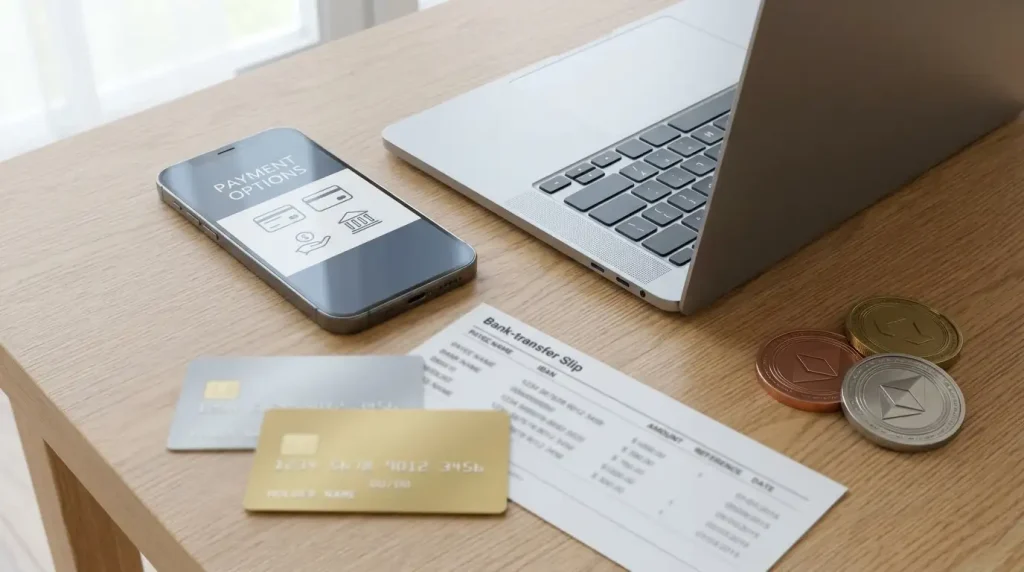
Winshark uses a hybrid payment model. Its published payment roster spans card and bank-style rails, e-wallets and prepaid methods alongside several cryptocurrencies. The currency list is similarly mixed, with EUR and AUD appearing next to BTC, ETH, USDT and other supported balance currencies.
The practical limit is country-level cashier variation. A method appearing in the broader Winshark payment roster does not mean it appears for every account or location. The cashier is the place where the available method set, transaction fields and any method-specific conditions resolve for a particular user.
Table of Contents
- A hybrid cashier spans fiat and crypto
- Crypto rails require network details at the transaction step
- Fiat rails cover cards, wallets, transfers and vouchers
- The currency list mixes fiat and crypto balances
- Deposit fees and external payment costs are separate layers
- Country-dependent cashier variation decides the final method set
- Match the payment rail to the transaction you are making
- Questions about Winshark payments
- A broad method roster still resolves at the cashier
A hybrid cashier spans fiat and crypto
The payment roster combines two different families. On the fiat side, it lists MasterCard, bank transfer, Paysafecard or Paysafe Card, Skrill, Rapid Transfer, MiFinity, Neteller, Revolut, CASHlib, Neosurf and BLIK. Binance is also listed as a deposit method. On the crypto side, the roster includes Bitcoin, Ethereum, Litecoin, Bitcoin Cash, Tether and Cardano.
This breadth has a practical consequence: the label “payment method” can refer to very different settlement systems. A card or e-wallet transaction follows a provider’s payment flow, while a crypto transfer depends on the selected asset, destination details and blockchain handling. Treating every rail as interchangeable can obscure where fees, timing and reversibility come from.
- Card and bank rails: MasterCard and bank transfer.
- E-wallet and transfer services: Skrill, Neteller, Rapid Transfer, MiFinity and Revolut.
- Prepaid or voucher-style methods: Paysafecard, CASHlib and Neosurf.
- Other listed methods: BLIK and Binance for deposits.
- Crypto assets: Bitcoin, Ethereum, Litecoin, Bitcoin Cash, Tether and Cardano.
For the separate rules that apply after a player requests a cashout, see the Winshark withdrawals guide. It keeps caps, timing and verification distinct from the broader deposit-method catalogue.
Crypto rails require network details at the transaction step
A coin name identifies the asset, but it does not by itself identify every transaction detail. Network selection, destination format and any blockchain cost need to be taken from the payment dialog used for the transfer. That is especially important for assets that may exist across more than one network in the wider crypto ecosystem.
The table separates the payment-method roster from the currency list and from details that resolve only when a transaction is created. It avoids assigning a network, minimum, processing time or blockchain charge that is not part of the published payment facts.
| Crypto asset | Published currency context | What the listing establishes | Transaction-specific detail |
|---|---|---|---|
| Bitcoin | BTC appears in the supported currency set | Bitcoin is included in the crypto payment roster | The receiving address and transfer route belong to the individual transaction |
| Ethereum | ETH appears in the supported currency set | Ethereum is included as a crypto rail | The asset name alone does not determine every routing field shown by the payment dialog |
| Litecoin | LTC appears in the supported currency set | Litecoin forms part of the listed crypto mix | Destination data is generated for the selected transfer rather than inferred from the coin name |
| Bitcoin Cash | BCH appears in the supported currency set | Bitcoin Cash is listed separately from Bitcoin | BCH transaction details need to remain distinct from BTC destination data |
| Tether | USDT appears in the supported currency set | Tether is part of the listed crypto payment options | The payment dialog supplies the route and destination details for the transfer |
| Cardano | Cardano is named in the crypto payment roster | The roster includes Cardano as a payment asset | The transaction interface provides the destination information used for that payment |
The separate deposit-fee listing states no casino deposit fee. That casino-level line does not define blockchain, wallet-provider or conversion costs outside the casino. Crypto transfers also carry price-volatility and irreversibility risk independently of the casino’s own fee policy.
Fiat rails cover cards, wallets, transfers and vouchers
The fiat side is broader than a single card option. MasterCard sits alongside bank transfer, e-wallets, transfer services and prepaid products. That spread can matter for how a user moves money, because each rail can have its own provider process even when the casino itself lists no deposit fee.
- Start with the methods actually shown in the cashier for the account and location.
- Check the transaction currency before confirming the payment.
- Read any provider-side fee or conversion notice presented before authorisation.
- For cashouts, check the separate withdrawal rules instead of assuming the deposit method determines the entire withdrawal path.
The method roster includes products associated with different markets, which is another reason not to treat the full list as a country-specific menu. The facts support a broad product catalogue and country-dependent cashier variation; they do not support a claim that every named method appears for every user.
Once funds are on the account, payment mechanics and game delivery are separate layers. The games and providers overview covers slots, live dealer and table-game formats without turning a payment method into a game feature.
The currency list mixes fiat and crypto balances
Winshark’s published currency set includes EUR, USDT, ETH, BTC, BCH, LTC, NOK, AUD, CAD, PLN, DKK, CHF and NZD. That mix is consistent with the hybrid payment model: conventional fiat currencies sit beside crypto-denominated balances.
A listed account or payment currency should be read separately from a payment method. AUD appearing in the currency list, for example, says that AUD is part of the published currency set; it does not prove that every payment rail in the wider catalogue is available for an Australian account. Method availability still resolves at cashier level.
| Currency group | Listed examples | Practical reading |
|---|---|---|
| Fiat | EUR, NOK, AUD, CAD, PLN, DKK, CHF, NZD | Account or transaction currency context |
| Crypto | USDT, ETH, BTC, BCH, LTC | Crypto-denominated balance or transfer context |
Currency choice can also affect conversion exposure when a payment source and account balance use different denominations. That is a general payment consideration, not a Winshark-specific conversion-fee claim. The payment facts do not supply a brand conversion spread, so none is assigned here.
Deposit fees and external payment costs are separate layers
The payment listing shows no casino deposit fee. That is useful as a casino-level policy signal, but it does not collapse all possible transaction costs into zero. Banks, card issuers, e-wallets, currency conversion and blockchain transfers can create costs outside the casino’s own fee line.
For crypto, network costs and price movement can change the value that arrives or is later realised. For fiat, conversion or provider charges can matter when the funding source, payment rail and account currency differ. Those are payment-system considerations rather than additional Winshark fee figures.
This separation also prevents a common reading error. “No casino deposit fee listed” is not equivalent to “the transaction has no cost under any circumstances.” It is a narrower statement about the casino’s listed fee policy.
Country-dependent cashier variation decides the final method set
Winshark’s payment information is best read as a roster of supported rails rather than a fixed menu for every country. The cashier method set varies by country, so the final available combination depends on what the account is shown at transaction time.
That variation has several consequences. A method can exist in the global roster without appearing for a particular location. A listed currency can exist without being paired with every method. A general fee statement can apply at casino level while a payment provider still presents its own costs or conditions.
The product-level takeaway is therefore about structure: Winshark supports both fiat and crypto rails, with a broad currency set, while the cashier resolves the actual method choices. That is the useful level of certainty the payment facts support.
Match the payment rail to the transaction you are making
The broad method list is most useful when it is broken into transaction decisions rather than treated as one undifferentiated menu. A deposit starts with the rail the cashier offers, the currency attached to that rail and any provider-side conditions shown before authorisation. A crypto transfer adds the need to confirm the asset and destination details before sending funds, because irreversible transfers leave little room to correct a mistaken destination.
A later withdrawal is a separate flow. The existence of a deposit method does not by itself define the cashout route, approval sequence or processing window. Winshark’s withdrawal rules therefore belong in the dedicated cashout section, where caps, timing context and verification can be read together instead of being inferred from the deposit roster.
This approach also makes the currency list easier to use. The account currency, payment currency and the denomination of a crypto asset can be different layers of the same transaction. Checking each layer before confirming a payment is more informative than assuming that a listed currency automatically pairs with every method in the catalogue.
Questions about Winshark payments
Which crypto assets are listed for Winshark payments?
The listed crypto set includes Bitcoin, Ethereum, Litecoin, Bitcoin Cash, Tether and Cardano.
Which fiat payment methods appear in Winshark’s payment roster?
The listed roster includes MasterCard, bank transfer, Paysafecard, Skrill, Rapid Transfer, MiFinity, Neteller, Revolut, CASHlib, Neosurf and BLIK.
Does Winshark list AUD among its currencies?
Yes. AUD appears in the published currency list alongside EUR, several crypto assets and other fiat currencies.
Are all listed payment methods available in every country?
No. The cashier method set varies by country, so the broader roster is not a promise that every method appears for every account.
Does the payment listing show a casino deposit fee?
The payment listing shows no casino deposit fee. Payment-provider or blockchain costs are separate considerations.
A broad method roster still resolves at the cashier
Winshark combines conventional payment services with six listed cryptocurrencies and a mixed fiat-and-crypto currency set. The useful reading is not that every method is universally available, but that the platform is built around multiple funding rails whose final availability is determined in the cashier. Keeping casino fees, provider costs, currencies and crypto-network details as separate layers gives a clearer picture of what the published payment information actually means.