
Winshark games, live casino and providers
 Available in US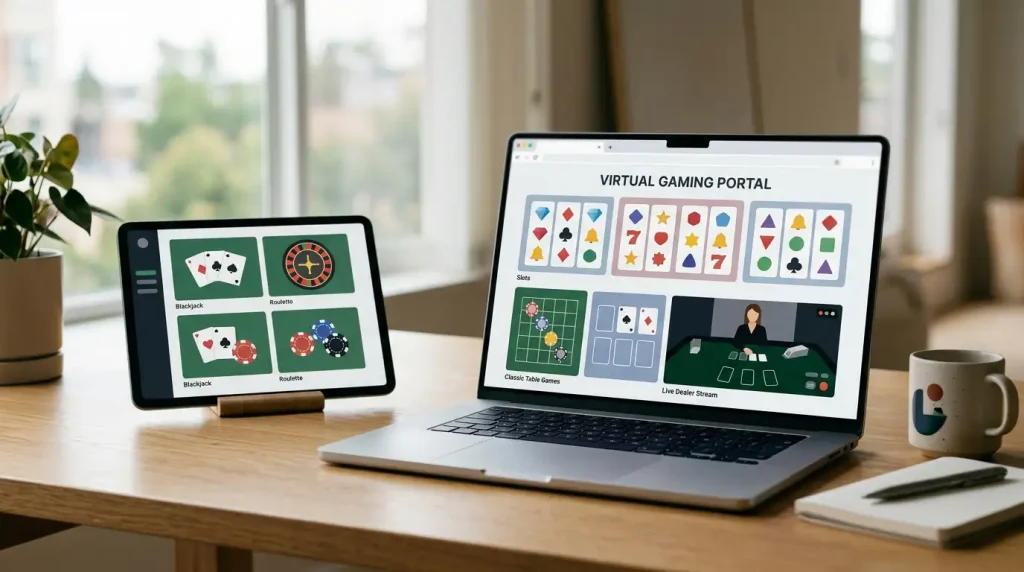
Winshark’s game catalogue spans slots, live dealer tables and familiar casino table formats including blackjack, baccarat and roulette. The product is delivered through the browser, so the useful way to understand the catalogue is by format, provider mix and device access rather than by a single headline game count. Funding sits in a separate layer: the payment-method overview covers the fiat and crypto rails used around the account.
Table of Contents
- The catalogue spans slots, live dealer and classic table formats
- Browser delivery keeps device access relatively simple
- Live casino adds a different rhythm from digital tables
- The provider roster points to a broad mix of game styles
- An audit claim is not a substitute for game-level rules
- Game choice and cashout mechanics are separate decisions
- Questions about Winshark games
- Provider breadth is useful only when game-level rules stay in view
The catalogue spans slots, live dealer and classic table formats
The game categories include slots, live dealer, blackjack, baccarat, roulette and other table and casino games. That mix separates the product into three broad experiences: machine-style games, streamed dealer tables and digital table formats.
| Game family | Named formats | How the format behaves in practice |
|---|---|---|
| Slots | Slots | Round-based games with rules, paytables and volatility characteristics set at game level |
| Live dealer | Live casino tables | Streamed tables where a human dealer runs the game and the browser carries the video and betting interface |
| Table games | Blackjack, baccarat, roulette | Rule-based casino formats where table rules and bet types matter more than a catalogue-wide average |
That last point is important when comparing games. A casino catalogue can contain many products under one category, but RTP, rules, limits and volatility belong to individual titles or tables. A broad category label therefore tells you the type of play, not the mathematical profile of every game inside it.
For a player moving between formats, the practical shift is from interface and pacing to rules. Slots generally present repeated rounds against a paytable. Live dealer tables add streamed interaction and table-specific limits. Blackjack, baccarat and roulette each have their own rule structures, so the game screen and rules panel remain the right place to inspect a particular title before staking money.
Session pacing can also change the amount wagered without any change to the nominal stake. A fast sequence of short rounds can produce more total bets over the same period than a slower live table. That makes round count, session duration and stake size three separate controls. Looking only at the stake per round can understate how much money moves through a longer or faster session.
The format split is therefore useful for planning behaviour as well as finding games. Slots emphasise repeated software-driven rounds, live tables add dealer pacing and streaming, and digital table games sit between those experiences with rule-based play but no live video requirement. None of those categories removes variance or loss risk; they simply organise different ways of placing casino bets.
Browser delivery keeps device access relatively simple
Winshark presents its games as playable directly through a web browser. That means the core route to the catalogue does not depend on installing a separate native application before opening a game. On phones and tablets, the browser becomes the access layer for navigation, game loading and account functions.
Browser delivery has a few practical consequences:
- the same account can be reached from common desktop and mobile browser environments;
- game sessions depend on the browser, device performance and network connection rather than an app-store update cycle;
- live dealer streams can demand more stable bandwidth than a lightweight slot or table-game interface;
- portrait and landscape orientation can change how controls and video are arranged on smaller screens.
Those are general browser-play considerations rather than brand-specific performance promises. The useful brand fact is simpler: the games are delivered through the web, including on mobile devices. For live content, a reliable connection matters because video and interaction have to stay synchronised with the table.
Live casino adds a different rhythm from digital tables
Live dealer games are part of Winshark’s catalogue. The main distinction is not merely visual. A live table follows the pace of a streamed dealer and table round, while a digital table or slot can move according to the software’s own round flow and the player’s actions.
That changes what deserves attention before a session:
- Check the specific table rules and bet limits on the game screen.
- For streamed games, make sure the connection is stable enough for continuous video.
- Read side-bet terms separately from the base game because they can have different mathematical characteristics.
- Treat session length and stake size as separate decisions; faster rounds can increase total money wagered even when the stake per round stays unchanged.
A live-casino label does not imply the same rules across every table. Blackjack variants can differ in dealing rules and side bets, roulette tables can differ in wheel or rule format, and baccarat tables can present different betting menus. The product category tells you where to look; the individual table supplies the rules that govern a particular wager.
The provider roster points to a broad mix of game styles
The named provider roster includes Pragmatic Play, Play’n GO, Quickspin, BGaming, Yggdrasil Gaming, Booming Games, Nolimit City, Evoplay, Ezugi, Playtech, Spribe, Push Gaming and Wazdan, among others. The list combines studios associated with slots, live products and newer browser-based game formats.
Provider names are useful for navigation because players often recognise interface patterns, volatility styles or game families from studios they already know. They should not be used as a shortcut for the rules of a particular title. Two games from the same supplier can differ substantially in paytable, feature frequency, maximum stake or session pace.
| Provider examples | What the roster tells you | What still belongs to the individual game |
|---|---|---|
| Pragmatic Play, Play’n GO, Quickspin | Multiple established content studios appear in the catalogue | Rules, paytable, RTP and volatility of each title |
| BGaming, Yggdrasil Gaming, Booming Games, Nolimit City | The catalogue is not tied to a single studio or design family | Feature mechanics, stake range and round behaviour |
| Evoplay, Push Gaming, Wazdan, Spribe | Modern browser-oriented formats sit alongside conventional casino content | Game-specific controls, odds and session characteristics |
| Ezugi, Playtech | The roster also includes suppliers known for live and broader casino content | Table-specific limits, rules and side bets |
The provider list is therefore most useful as a catalogue map. It signals variety across suppliers without turning provider identity into a numerical quality score or a claim about a specific game’s return profile.
An audit claim is not a substitute for game-level rules
Winshark says its games are audited by independent experts. That is a broad statement about oversight. It is different from the information a player needs to evaluate an individual game, where rules, paytable, stake range and any published RTP belong to the specific title or table.
The distinction matters because “audited” and “favourable” are not synonyms. An audit can address whether game behaviour follows defined rules or technical requirements; it does not remove house edge, variance or the possibility of loss. Gambling outcomes remain uncertain, and short sessions can move far away from long-run mathematical expectations.
For practical use, treat the game’s own information panel as the starting point for mechanics. In a slot, that means the paytable and feature rules. At a live table, it means the table limits, base-game rules and side bets. In roulette or baccarat, it means the exact bet types on that table. Those details are more decision-relevant than a catalogue-wide label.
Game choice and cashout mechanics are separate decisions
Game format determines how money is wagered; payment and withdrawal rules determine how funds enter and leave the account. Keeping those layers separate avoids a common mistake: a fast game round does not imply a fast cashout, and a familiar payment method says nothing about a game’s rules or house edge.
If the practical concern is how larger balances leave the account, the withdrawal limits and timing section explains the EUR 500 per 24-hour and EUR 10,000 monthly caps, processing windows and verification stage. For the wider product picture, the Winshark overview connects games with payments, support and mobile access.
This separation is particularly useful on a hybrid platform. Crypto and fiat rails can change the mechanics of moving value, while the game itself still follows its own rules. Volatility in a crypto asset can affect the value of funds outside the game; it does not alter the mathematical rules of a slot, blackjack table or roulette wheel.
Questions about Winshark games
What kinds of games does Winshark offer?
The game mix includes slots, live dealer, blackjack, baccarat, roulette and other table and casino games.
Does Winshark have live casino games?
Yes. Live dealer games are part of the game catalogue.
Can Winshark games run in a web browser?
Yes. Winshark presents its games as playable directly through a web browser.
Which game providers are associated with Winshark?
Examples include Pragmatic Play, Play’n GO, Quickspin, BGaming, Yggdrasil Gaming, Booming Games, Nolimit City, Evoplay, Ezugi, Playtech, Spribe, Push Gaming and Wazdan.
Provider breadth is useful only when game-level rules stay in view
Winshark combines slots, live dealer tables and familiar casino games with a roster spanning numerous named suppliers, all delivered through the browser. The useful takeaway is breadth of format and provider choice, not a single catalogue-wide mathematical profile. Rules, stakes and risk still resolve at the individual game or table, which is where a player should focus before starting a session.