
Table games use shared playing surfaces, defined rounds and rules that shape wagers, choices and outcomes.
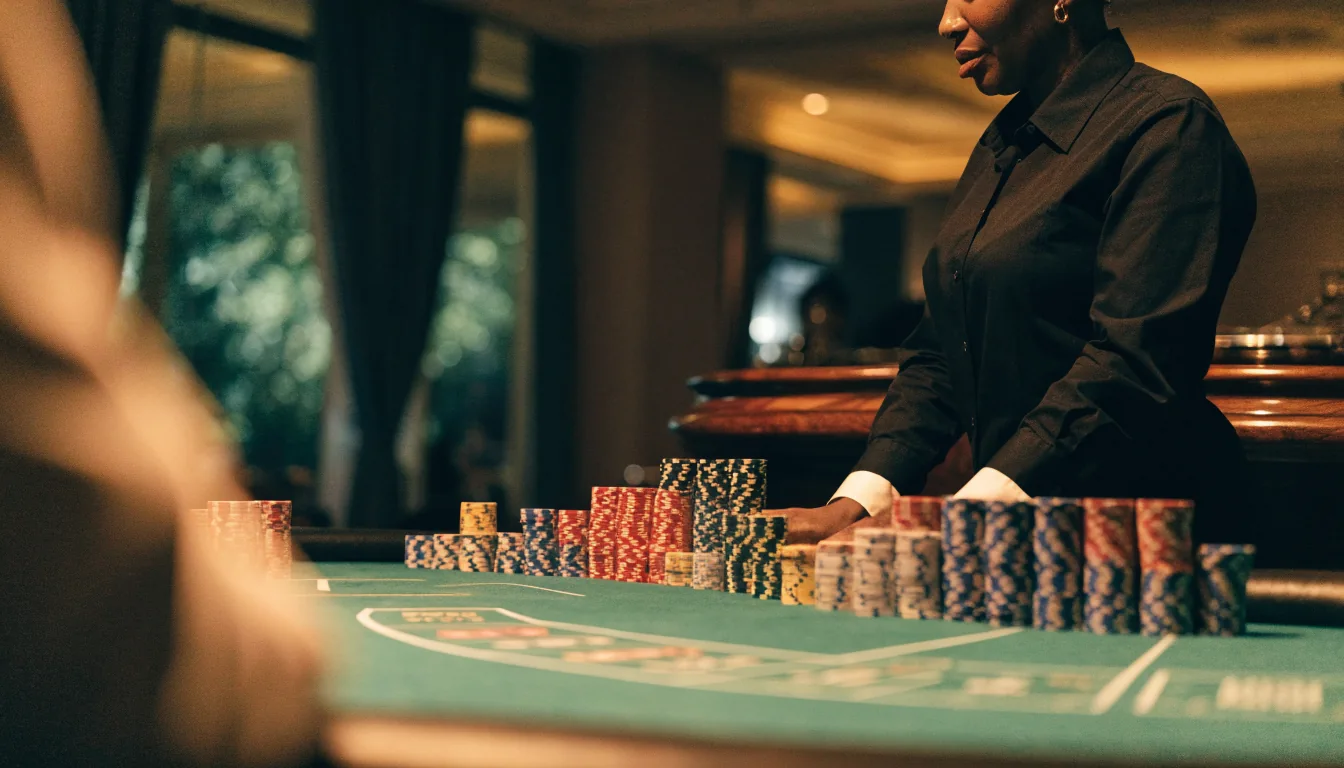
A casino table game is a game organised around a shared playing surface, a set of rules and a clear way to place bets or make decisions. The table is part of the format, not just furniture: it gives players a common place to follow the action and shows where play is taking place.
That is the useful distinction between table games and other casino games. A table game has a defined round or sequence of play, with actions that matter within those rules. Depending on the game, you might make a choice about your own play, place a wager on an outcome, or compete against another participant. The details change, but the basic idea stays the same: you act within a structured game rather than simply interacting with a game that has no shared table format.
The phrase “casino table games” covers different kinds of play, so it does not describe one single set of rules. Blackjack, for instance, puts a player against the dealer. The aim is to finish with a hand value closer to 21 than the dealer’s. In a dice game, players roll a pair of dice and bet on the outcome. Poker has a different shape again: players compete to build the best possible hand. Those examples show why it helps to ask how a game is organised, rather than assume every table game works alike.
For real-money casino table games in Australia, it is worth checking each operator’s available licensing and payment details before choosing where to play. This list gives you a concise reference to the information provided for each site.
Rollero Casino
Rollero Casino is listed with a Curacao Gaming Control Board licence, OGL/2023/176/0095, held by Hollycorn N.V.
Playfina Casino
Playfina Casino is associated with Hollycorn N.V. and has held a Curacao eGaming licence since 2017. Its minimum deposit is A$20–30, depending on the offer.
7Bit Casino
7Bit Casino is operated by Dama N.V. and holds a Curacao licence.
Golden Pokies
Golden Pokies is listed with a Curacao licence.
WinSpirit Casino
WinSpirit Casino holds a Curacao eGaming licence, OGL/2024/923/0383, issued to Antillephone N.V. Its minimum deposit is A$30.
MrPacho
MrPacho lists crypto payouts in 30–120 minutes and fiat payouts in 24–72 hours. The minimum deposit is A$30.
Wild Tokyo
Wild Tokyo holds a Curacao licence and lists a minimum deposit of A$10. Its stated payout times are 30–60 minutes for crypto and 1–5 days for fiat.
Ricky Casino
Ricky Casino lists crypto payouts in under an hour and PayID payouts in 1–3 business days. The minimum deposit is A$20, or A$30 to qualify for the bonus.
Kingmaker
Kingmaker lists crypto payouts at around 90 minutes and fiat payouts in 1–5 days. Its minimum deposit is A$30.
DragonSlots Casino
DragonSlots Casino is listed with a Curacao Gaming Authority licence held by Jumpman Gaming Ltd.
A table may bring several players together, but that does not mean they all have the same role. In one game, you are measured against the dealer; in another, the bet concerns what the dice produce; in poker, players are trying to form the strongest hand. The rules define which actions count and how the result is judged. Without those rules, a table and a wager alone would not tell you what kind of game you are looking at.
When you are trying to understand what table games are in a casino, start with three simple points: what the game is about, what a player does, and how the rules determine the result. That gives you a practical description without pretending that every game asks for the same decisions. It also keeps “table game” from becoming a loose label for any casino activity.
I find that distinction more useful than a long list of names. Once you know whether the game centres on a dealer, a dice outcome or competing hands, you have the basic vocabulary to follow a description of it. The specific rules still matter, of course. A shared table does not make the games interchangeable.
An online table game can be presented in two quite different ways: as a computer-generated game or as a live video stream from a table with a real dealer. The screen may look similar at a glance, but the event behind it is not the same. In one format, software determines the result; in the other, a dealer and physical casino equipment are shown on camera.
In a computer-determined version, a Random Number Generator (RNG) determines the outcome. For a card game, it decides which cards are dealt. For roulette, it determines where the ball lands. The result is therefore produced by software rather than by a physical dealer dealing cards or spinning a wheel in the room with you.
What you see is a digital presentation of that process: the game’s table, cards or wheel appear on screen, and the outcome is shown there. The interface represents the game, while the RNG supplies the result. A digital table can resemble a casino layout, but its appearance does not mean a physical table is being used.
That distinction matters when you are trying to understand how a particular online casino table game is produced. A computer-generated version is not a recording of a dealer’s actions. Nor is it a live view of a physical wheel. The displayed result comes from the software’s random determination.
The same broad distinction applies whether the screen shows cards or a roulette wheel. The game’s visual design may change, but the key point is the source of the outcome: an RNG. The interface is how the result is presented to you.
A live dealer game uses a real dealer and real casino equipment. A camera captures the table, and the video is streamed to players. Instead of seeing only a computer-rendered game, you see a live image of the dealer and equipment used in the game.
The stream is the defining part of the format. The action shown is taking place at a physical table, rather than being generated entirely as a digital scene. You are watching the event through video; you are not sitting beside the table. The dealer and equipment are real, while the way you view them is mediated by the online stream.
This is why a live dealer screen can feel different from a computer-generated one even when both are described as table games. In the streamed format, the dealer and physical equipment are visible. In the computer-generated format, the screen depicts the game, and software determines the outcome. Those are production differences, not just different visual themes.
A polished digital table does not, by itself, tell you whether the game is live. Likewise, a live-looking layout is not proof that a dealer is physically present. To tell the formats apart, look for what is actually being presented: an RNG-generated game display, or a live video stream showing a real dealer and casino equipment.
That simple check helps make sense of casino table games online. The words “online table game” describe where you view the game, not necessarily how its result is produced. One version can be computer-determined; another can show a live dealer handling real equipment. The screen is the point of contact in both, but the underlying production is different.
The distinction also stops a common mix-up: digital presentation does not mean a live game, and a live video feed does not mean the outcome is being produced by the same process as a computer-generated version. In the first case, the RNG determines the cards or roulette outcome. In the second, the player sees a real dealer and equipment through a live stream.
When you encounter descriptions of online casino table games, separate those two questions in your mind: what is shown, and how is the result produced? The answer is straightforward for the formats described here. A computer-generated game uses an RNG to determine its outcome; a live dealer game streams a real dealer and casino equipment to the screen. No mystery.
Australia’s online casino rules are built around the Interactive Gambling Act 2001. The Act restricts the supply of real-money interactive gambling services to people in Australia. That includes online casino-style games such as table games, whether presented as a live dealer session or through a digital game interface.
Section 5 is central to the framework: operators based in Australia are prohibited from offering real-money interactive casino games to Australian residents. The wider law also bars local companies from providing online casinos. In practical terms, a website’s Australian branding or a table-game catalogue does not make its real-money casino service lawful to provide here.
Legal Restriction
Under the Interactive Gambling Act 2001, operators based in Australia are prohibited from offering real-money interactive casino games to Australian residents.
The rules concern the service being offered, not just the name attached to a game. Online blackjack, roulette and poker, for example, fall within the category of casino-style interactive gambling services when supplied for real money to customers in Australia. That is why a search for a casino with table games cannot be treated as a simple directory question: the legal status of the service matters.
The Australian Communications and Media Authority (ACMA) is the regulator responsible for enforcing the online gambling framework. Its role includes taking compliance action and blocking unlicensed domestic platforms. A block is an enforcement measure, not an endorsement of other sites or confirmation that a service is lawful simply because it remains reachable.
The distinction between the rules for providers and a player’s position is worth keeping clear. The law places restrictions on supplying prohibited services to people in Australia; it does not turn an overseas company’s claim about its own status into proof that the service complies with Australian law. Nor does the presence of live casino table games on a site change the basic legal test.
You may see claims that offshore casinos sit outside Australian law. That is not a sound basis for treating real-money online casino services as permitted here: the relevant question is whether the service is being supplied to people in Australia. ACMA’s enforcement role forms part of the framework, while the Act sets the underlying restriction.
So, if you are checking whether a list of online casino table games represents a lawful real-money offering for Australian customers, the game names alone do not answer it. The governing rules concern the provision of the service to people in Australia, and local operators are prohibited from offering it. A tidy catalogue is not a legal status.
A useful comparison starts with how a game is produced, not with a claim that one table is “best”. Online table games generally fall into two broad formats: a computer uses a Random Number Generator (RNG) to determine an outcome, or a live dealer runs the game with real casino equipment while video is streamed to players. Those are different ways of presenting play, not a ranking.
With an RNG-based version, the result is generated by software. In a card game, the system determines which cards are dealt; in roulette, it determines where the ball lands. What you see is the digital table and its on-screen representation of that result. The dealer-streamed format instead shows a real dealer and physical equipment through live video. You watch the table as the dealer runs it.
That gives you a straightforward comparison point: do you want a software-generated presentation, or one showing a human dealer and real equipment? The difference is about the source and display of the game outcome. It does not, by itself, tell you which format is more enjoyable, fairer or more suitable for a particular player.
Software uses a Random Number Generator to determine outcomes, presenting the game through a digital interface.
Real dealers and physical equipment are captured via camera and streamed live to the players.
You can also compare what the interface makes visible. A software version presents the table through the game screen; a live format adds the dealer and streamed view. The exact layout and features depend on the individual game, so it is better not to assume every digital table works the same way. Look at what is actually shown rather than relying on a label such as “live” or “classic” to explain the whole experience.
People sometimes treat Bitcoin table games as if they were a separate kind of game. The key distinction is simpler: Bitcoin describes a payment method, while RNG and live dealer describe how a table game is generated and presented. Those categories answer different questions.
So, when comparing Bitcoin with conventional casino payments, separate the payment arrangement from the game itself. The currency or payment method does not, on its own, change whether software determines the result or a real dealer handles equipment on camera. Nor does mentioning Bitcoin establish that a particular service accepts it. That depends on the service and its terms, and it should not be assumed.
For anyone in Australia, there is another reason to keep the distinction clear: a technical payment option does not change the legal status of a real-money online casino service. This comparison is about formats, not a recommendation or invitation to access one.
There is no sound universal ranking of the best casino table games based only on whether they are streamed or RNG-based. Those labels describe production. They do not establish a winner, and a “top” list would need a clear basis for comparison rather than a bold heading.
Instead, decide what aspect you are comparing. Is the distinction between a software-generated result and a visible dealer important to you? Do you prefer the digital table presentation, or do you want to see real equipment in a live stream? Those are concrete format preferences. They are more useful than treating “best table games” as a single objective category.
When you encounter a game described as a felt-table or tabletop experience, focus on the same distinction: is the result generated by an RNG, or is a real table shown through a live stream? The wording alone does not answer that. Check the description of how the game operates, and keep payment terms separate from game format.
A neat comparison, then: software result or streamed table. Bitcoin is a separate issue, and “best” needs a criterion before it means anything.
A “best odds” table-game list sounds precise, but it needs comparable figures behind it. A ranking based on a game’s name alone can hide the details that determine what a particular figure means. Without comparable information, calling one table game better than another is more confident than the evidence allows.
RTP is one measure people often look for. It describes the theoretical share returned to players over a very large number of plays. But the RTP information discussed for pokies concerns millions of spins; it is not a general figure for casino games. It cannot be carried across to blackjack, poker, roulette or another table game as if they all used the same calculation.
Volatility has the same limitation. Also called variance, it describes how a pokie distributes its payouts. It is not a measure that ranks table games by their odds. A game with a particular volatility profile is not thereby shown to offer a better or worse chance at a table.
That distinction matters when you see a “house edge chart”. A chart can look authoritative while leaving the important question unanswered: which rules, bets and conditions does each number describe? A figure without that context is difficult to compare, and a neat ranking can make unlike measures look interchangeable. Charts are tidy. The comparison may not be.
The phrase “best odds at casino table games” can also mean different things. Someone may be asking about the chance of a particular outcome, the potential return attached to a wager, or how a game compares over repeated play. Those are not automatically the same measure. Before relying on a ranking, check what its figures represent and whether the same basis is used throughout.
For a useful comparison, the measure should be stated plainly and tied to the specific version and wager being assessed. A general label such as “blackjack” or “roulette” does not, by itself, tell you what number to compare. Nor does a figure for one kind of casino game establish the odds for another.
So, what casino table games have the best odds? The RTP and volatility descriptions for pokies cannot answer that question, and they do not support a table-game ranking. That is not evidence that all table games have identical odds; it simply means these measures do not establish which one is best or worst. A reliable answer needs relevant, comparable table-game figures, rather than a pokie statistic pressed into service.
When you encounter claims about the best or worst odds, look for a clear definition of the measure and the conditions it applies to. If those are not stated, treat the ranking cautiously rather than treating its order as a settled comparison. A chart is only as useful as the figures and definitions behind it.
When you sit down to play a table game, the decisions depend on what the game asks you to do. In blackjack, you are trying to finish with a hand value closer to 21 than the dealer’s. In a dice game, you roll a pair and bet on the outcome. In poker, players compete to build the best possible hand. Those are three different rhythms: compare, predict, and assemble.
Blackjack puts your hand beside the dealer’s as the point of comparison. Your aim is not simply to reach 21; it is to have a value closer to that target than the dealer’s hand. That gives each decision a clear reference point. You are weighing your hand against the dealer’s, rather than trying to beat every other player at the table. If you are learning how to play table games at a casino, that opponent-and-target structure is a useful place to start.
The broad objective is straightforward, but the game still asks you to follow its rules and consider what your hand means in relation to the dealer. Don’t confuse a simple aim with a game that plays itself. The choices are tied to the hands in front of you.
Dice betting has a different feel. Players roll a pair of dice and bet on the outcome. You are making a wager connected to what the roll will produce, then the roll settles that round. It is a compact sequence: place a bet, roll, see the result. There is no hand to build or dealer’s total to compare against. The key is understanding the outcome your bet concerns before the dice are rolled.
Poker shifts the focus back to cards, but the central task is building the strongest possible poker hand. Players are competing against one another to put together the best hand, so attention stays on what each player can make from their cards. The aim is easy to state; the contest is in how the hands compare. Poker is not just a matter of receiving cards and waiting for a result.
That contrast helps when you are deciding what kind of table play you want to learn. Blackjack centres on your hand versus the dealer. Dice play connects a bet to a roll. Poker is a contest to make the best hand. None of those descriptions requires you to memorise a catalogue before you understand the basic shape of play.
If you are new, take the objective one game at a time. First, be able to explain what the game is measuring: a hand’s closeness to 21, a dice outcome, or the strength of a poker hand. Then follow the table’s rules before placing a bet or making a decision. It is a modest habit, but it saves you from treating different games as if they ask for the same choices.
People often look for the best table games to play at a casino, but “best” depends on the sort of decision you want to make. Some players may prefer comparing a hand with a dealer’s; others may like betting around a dice roll or competing to make a strong poker hand. Start with the objective you can explain plainly. The rest follows from the rules.
If you want a casino close by, the useful question is not just how far away it is. You also need to confirm that the venue is open when you plan to go and that it currently offers the kind of table play you have in mind. A map pin can show distance; it cannot tell you what is operating on the floor today.
I can’t name an Australian venue here or confirm which local venues offer table games. So treat any nearby result as a lead to check, not as proof that you’ll find a particular game waiting. Venue details can change, and a broad label such as “casino” does not establish which tables are available.
Start with your actual travel area, rather than a generic search for the nearest casino. “Near me” depends on where you are and how you intend to travel. A venue that looks close in a straight line may be awkward to reach; another farther away may suit your route better. Use a map to compare locations, then check the venue’s own current information for opening details and available facilities.
For table games specifically, look for an explicit description of table play. If the information is unclear, contact the venue and ask directly whether it offers the game you want and whether it will be available at the time of your visit. That is more useful than relying on an old directory entry or a photograph that happens to show a table.
Be precise when asking. “Do you have table games?” may get a broad answer, while asking about the particular format you want can reveal whether the venue has what you mean. If you are travelling with someone else, check that the venue’s arrangements suit both of you before setting out. Small checks save a wasted trip.
Some people use location searches that name places such as Miami or Ohio. Those results relate to a different location; they do not help identify a nearby Australian venue. Make sure the map is centred on the place where you actually plan to go, especially if your device or browser is using a saved location.
I’d also separate “a casino is nearby” from “the table I want is available.” The first is a location question; the second needs current confirmation from the venue. A listing may be useful for finding an address, but it should not be treated as a live schedule or a complete guide to the games on offer.
If you cannot confirm table availability, keep your plans flexible rather than assuming the listing settles it. Check the venue’s current information shortly before travelling, and ask about any details that matter to your visit. No guesswork needed.
Card games at a casino table can involve different ways of placing a wager. In one format, the choices are to bet on your hand, the Banker’s hand or a tie. That gives you three possible outcomes to consider before a hand is decided; the wager is tied to which outcome you select.
The Banker’s hand is one side of the comparison, not a separate player’s personal hand. A tie is a distinct option alongside the two hands. Keeping those choices clear is the useful starting point: you are not simply choosing a card or trying to assemble a hand yourself. You are selecting which of the listed outcomes your bet will support.
That structure is often associated with baccarat, a card-table game where the wager can be placed on a hand, the Banker’s hand or a tie. The key point here is the shape of the betting choice, rather than a detailed account of how a hand is dealt or settled. Those details should not be assumed from the bet labels alone.
Poker has a different central aim. Players compete to build the best possible poker hand. The focus is on the hand each player makes, rather than on backing one of two named hands or a tie. That distinction helps separate the basic idea of poker from a format whose listed wagers are about which outcome occurs.
These are broad card-game concepts, not a complete catalogue of casino card games or a guide to every table rule. A table’s own instructions define how its options work, and a game name alone does not tell you every condition attached to a bet. Keep the two ideas separate: one format asks which hand or tie you are backing; poker centres on making the strongest hand. Simple distinction.
When you sit down to roulette, the first useful thing to notice is the wheel’s layout: the numbered pockets and the green zero pockets. Online, the main versions you’ll see are European, French and American roulette. The key distinction is how their pockets are arranged.
European and French roulette each have 36 numbered pockets and one green pocket marked 0. American roulette also has the numbered pockets, but its green pockets are marked 0 and 00. That extra green pocket is the quick visual clue when you’re telling the American wheel apart from the other two.
European and French roulette share that pocket arrangement. The names are different, but for identifying the wheel, the number of green pockets is what matters. American roulette is easy to spot: look for both zero and double zero.
That’s the basic format difference, without getting lost in table layout or bet choices. If you’re comparing casino table games, checking the wheel itself is a straightforward place to start. A game’s label tells you its version; the green pockets let you confirm what’s on screen.
The same distinction applies whether you come across roulette in a live setting or as an online table game. Take a moment to check the wheel before play begins. One green pocket marked 0 points to the European or French format; two, marked 0 and 00, point to the American format.
It’s a small detail, but it changes what you’re looking at. No guesswork needed.
Poker at a casino table centres on a contest between players: each tries to build the best possible poker hand. That shared objective is the clearest starting point, whether you are trying to understand casino poker table games for the first time or simply want to know what makes poker different from other table formats.
The key idea is competition. Players are not just trying to produce a strong hand in isolation; they are battling one another to have the strongest hand in the game. The appeal comes from that direct comparison. A hand matters because of how it stands against the hands of the other players.
You may see different forms of poker discussed under the broad casino-poker label. The name alone does not tell you every rule or how a particular format handles a hand. What remains central is the aim of building the best possible poker hand. It is a simple premise, even if a specific table’s rules can add detail.
If you are new to poker table games at a casino, keep that objective in view before worrying about terminology. Poker is about competing to make the strongest hand, not merely taking part in a card game. That gives you a useful way to understand the basic point of poker without assuming every version works in precisely the same way.
The same principle applies when people refer broadly to types of casino poker games: the precise format can vary, while the contest over the best possible hand remains the basic idea. For a first orientation, that is enough. No need to pretend the whole game is more mysterious than it is.
Yes, Australian players can play real-money table games on offshore platforms. Australian-based operators are prohibited from offering these games to residents.
Australian-based operators cannot offer real-money online casino games to residents, while offshore platforms accept Australian players under the stated legal framework.
They can, but table games may contribute only 10–20% toward wagering requirements, and some titles may be excluded. Check the game contribution table, wagering requirement and maximum bet in the bonus terms.
Direct bank transfers typically take 3–7 business days. PayID withdrawals average 1–4 hours, with some platforms delivering funds within 30 minutes during business hours.